Trading · The guide
What actually happens to most people who try day trading
The short answer
Mark’s first month of day trading went well. He put $6,000 into an account, traded most weekday mornings before work, and finished the month up about $900. He has screenshots. His losing days were small, his winners felt earned rather than lucky, and he has started, quietly, doing the arithmetic that every new trader does: $900 a month, compounding, scaling up as the account grows. His month is the most ordinary story in trading, and the question his screenshots cannot answer is the entire subject of this article: is Mark good, or is he early?
Almost everything written about that question is written by someone with a course, a platform, or a signal service to sell, which is why it usually arrives as a list of mistakes with a product-shaped solution at the bottom. This article does something different. Complete records exist: entire markets where researchers could watch every single person who tried day trading, for years, from their first trade to their last. Follow the cohort, not the survivor. The loud winners on your feed are real people; they are also the sliver that remains after the outcome this article describes has already happened to everyone else. The records say what happens to the whole group, and if you are deciding whether to try this, the whole group is the honest comparison set, because at the starting line every member of it felt exactly like Mark.
One definition before the evidence, since the word gets stretched. Day trading means opening and closing positions within the same day, over and over, profiting from moves measured in minutes and hours. It is a different activity from swing trading, which holds for days or weeks, and a different universe from investing, which holds for years and is the subject of a different section of this site. The numbers below are about day trading specifically, and they are not transferable to those calmer activities.
The number everyone repeats and nobody can produce
Search this question and you will meet a statistic within seconds: 90% of day traders lose money. Sometimes it is 95%. It appears in nearly every article on the subject, almost always without a source, because as far as anyone can trace, there is no single study behind it. It is folklore with a percent sign, passed from article to article the way rumors move, and the sites repeating it generally sell tools or training to day traders, which makes the vagueness convenient: a scary round number frames the product as the exception, and nobody has to engage with what the research actually measured.
Here is the uncomfortable joke underneath: the real numbers did not need inflating. The measured outcomes, from complete records rather than surveys or vibes, are bad enough that folklore was never required. But the difference between a rumor and a measurement matters, because measurements come with a market, a period, a sample size, and limitations you can weigh. Rumors just come with confidence.
What the complete records show
Two research settings tower over everything else written on this subject, because they did not sample or survey. They observed everyone.
The measured record
| What the records show | Where, and who measured it |
|---|---|
| More than 75% of day traders quit within two years | Taiwan Stock Exchange, complete records, 1992 to 2006. Barber, Lee, Liu, Odean and Zhang, 2017 |
| Of those who persisted 300+ sessions, 97% lost money | Brazilian equity futures, 2013 to 2015. Chague, De-Losso and Giovannetti |
| Fewer than 1% earn reliable profits net of fees | Taiwan Stock Exchange, 1992 to 2006. Barber, Lee, Liu and Odean, Journal of Financial Markets, 2014 |
More than 75% of day traders quit within two years
Where, and who measured itTaiwan Stock Exchange, complete records, 1992 to 2006. Barber, Lee, Liu, Odean and Zhang, 2017
Of those who persisted 300+ sessions, 97% lost money
Where, and who measured itBrazilian equity futures, 2013 to 2015. Chague, De-Losso and Giovannetti
Fewer than 1% earn reliable profits net of fees
Where, and who measured itTaiwan Stock Exchange, 1992 to 2006. Barber, Lee, Liu and Odean, Journal of Financial Markets, 2014
The Taiwan work, led by Brad Barber and Terrance Odean, used the complete transaction records of the Taiwan Stock Exchange across fifteen years, hundreds of thousands of individuals, every trade. Its conclusion is stated without hedging in the paper itself: “Less than 1% of the day trader population is able to predictably and reliably earn positive abnormal returns net of fees.”
The Brazilian study is younger and, if anything, harsher, because it answers the exact question a hopeful beginner is asking: can I do this for a living? Fernando Chague, Rodrigo De-Losso and Bruno Giovannetti followed every individual who began day trading Brazilian equity futures between 2013 and 2015 and stuck with it for at least 300 sessions, people who by any reasonable definition gave it a real try: “97% of them lost money, only 0.4% earned more than a bank teller (US$54 per day).” Their abstract’s first sentence is aimed directly at the industry selling the dream: “We show that it is virtually impossible for an individual to day trade for a living, contrary to what course providers claim.”
The honest limitations, stated rather than hidden: Taiwan in the 1990s and 2000s is not the United States in 2026, Brazilian futures are not your brokerage app, and trading costs have fallen since both studies ended.
Which raises the obvious question: has anyone measured American day traders? Yes, and the answer comes with a caveat about what kind of evidence it is. Douglas Jordan and J. David Diltz published a study of U.S. day traders in the Financial Analysts Journal in 2003, using two separate methods on a set of accounts at an American firm. Their headline: “about twice as many day traders lose money as make money,” with “approximately 20 percent of sample day traders” more than marginally profitable.
Two things about that 20%, because it looks at first like it contradicts Taiwan’s sub-1% and it does not. The two are answering different questions. Jordan and Diltz are counting who finished a stretch in profit; the Taiwan figure counts who could do it predictably and reliably, net of fees, year after year. Being in the 20% is compatible with having no skill at all, which the chart further down on how long luck can impersonate skill is entirely about. The second thing is the word sample: this is a set of accounts at one firm, where Taiwan and Brazil are complete national records of everyone who tried. So the American study is the more familiar market and the weaker evidence, which is exactly why the table above is built from the other two. It earns its place anyway, because it retires the easiest objection to them. The pattern is not a foreign artifact.
It is fair to hope today’s numbers are somewhat less brutal. It is not reasonable to expect them to be a different kind of number, because every serious dataset, across different markets, decades, fee regimes and instruments, points in one direction, and none of them is within shouting distance of a coin flip.
The two years that decide it
The folklore version of this subject says people lose. The records say something more specific: people leave. Watch what happens to a hundred beginners in the Taiwan data after their first month of real day trading.
The cohort, year by year
Two details in that study deserve more attention than the headline. First, almost nobody quits immediately: only 2.5% stopped within the first month, because first months are full of hope and, for many, full of beginner’s results like Mark’s. The leaving happens across the following two years, as the account statements accumulate into an answer. Second, the unprofitable were more likely to quit than the profitable, which sounds obvious until you see the exception the researchers documented: a meaningful group of experienced, consistently unprofitable traders who kept trading anyway, year after year, absorbing losses. The market had answered their question. They kept paying to hear it again.
That is the true shape of this activity: not a casino where everyone loses on schedule, but a slow filter, where the market charges monthly for an answer about your own ability, most people get a no within two years, and a fraction of those refuse the answer at extraordinary cost.
And if the plan is to be the exception through sheer accumulated experience, the Brazilian researchers tested exactly that hope across their 300-session veterans and reported it in five words: “no evidence of learning by day trading.” More screen time did not convert losers into winners. Whatever separates the thin winning tail from everyone else, the data says it is not something the market teaches you at this price, which is worth knowing before you enroll on those terms.
Lucky and good look identical, briefly
Back to Mark, up $900 after a month, and the question his screenshots cannot settle. Here is why they cannot, and it is arithmetic rather than psychology. Suppose a trader has no edge whatsoever: wins and losses of equal size, each equally likely, minus real-world costs (commissions, spreads, the gap between the price you wanted and the price you got) worth a twentieth of his typical risk on every trade. That trader’s future is certain in the long run, because costs never miss. His near future is anything but.
How long luck can impersonate skill
Read Mark’s month against that first bar. Two in five people with literally no ability would show a profitable first month under those assumptions, which means his screenshots contain almost no information yet, and neither would a losing month, in the other direction. This is the cruelest feature of trading as a learning environment: the feedback is loud, constant, and mostly noise for months. A beginner poker player who wins a night knows the feeling. The difference is the stakes: by the time trading’s sample size grows large enough to say something true about Mark, Mark has paid costs on every one of those trades, and if the answer is no, he has paid for it with exactly the money he was hoping to grow. The Taiwan attrition curve above is this chart operating on real people: the two years it takes to leave is roughly the time it takes for the noise to resolve into an answer.
The other side of the trade, and the tolls on the way there
One more structural fact the incumbents skip, because it is unflattering to their customers. A day trade is not a bet against “the market.” It is a bet against whoever took the other side of your specific order, seconds ago, and in modern markets that counterparty is overwhelmingly professional: firms with co-located servers, full-time researchers, and cost structures you cannot match. The Taiwan records add a bleaker detail about where the rest of the volume comes from: unprofitable day traders generated 72% of all day trading volume across the sample, rising to about 80% in the later years. The activity’s own paying customers, the consistently losing, supply most of the game.
Between you and that counterparty stand the tolls, and they apply even when your app advertises zero commission. The spread, the small gap between the price buyers pay and sellers receive, is charged on every round trip. Slippage, the difference between the price you wanted and the one you actually got, grows exactly when markets move fast, which is when day traders trade. And the toll almost nobody mentions: taxes. Profits on positions held under a year are short-term capital gains, and the IRS is direct about their treatment: “Net short-term capital gains are subject to taxation as ordinary income at graduated tax rates.” Long-term investors can pay 0%, 15% or 20% on their gains. A profitable day trader’s winnings are taxed like wages, at their highest applicable bracket, which means the rare trader who beats the market, the fees, the spread and the slippage still has to beat them by enough to hand back a wage-sized slice of the victory.
The rare exception is real, which is the strangest part
The tidy ending here would be “and therefore nobody can win,” and the records refuse to say it, so neither will I. In the Taiwan data, about 500 traders out of hundreds of thousands earned large, persistent profits: 61.3 basis points per day before fees, 37.9 after, year after year, identified in advance by their past performance rather than in hindsight. (A basis point is a hundredth of a percent; at their scale, those dozens of daily basis points were a living.) Skill at this exists. It is measurable, it persists, and it is concentrated in a group so small that the same paper puts the population of predictable after-fee winners below 1%. The Brazilian data adds a sobering footnote about even the winners’ lives: the single best performer in the entire 300-session cohort averaged US$310 a day, with a standard deviation of US$2,560, meaning the country’s champion day trader earned a good professional’s income on a ride wild enough that thousand-dollar swings against him were routine. That is what the top of this profession’s pyramid looked like in a complete national record.
Notice what fees did even at the extremes: they took roughly a third of the best traders’ edge, and they turned the bottom group’s modest before-fee losses (11.5 basis points a day) into much larger after-fee ones (28.9). Costs are the one participant in every trade that never has a losing day, which is why they decide the fate of the whole middle of the distribution: a trader with a small real edge can still lose after costs, and a trader with none loses faster.
What fees did at both ends of the distribution
So the honest sentence is not “day traders always lose.” It is this: the outcome distribution has a long, thin, real tail of professionals, and an enormous body of people who paid to discover they were not in it. The U.S. Securities and Exchange Commission, which regulates none of your optimism, put its own version plainly enough that I will hand it the paragraph:
“Most individual investors do not have the wealth, the time, or the temperament to make money and to sustain the devastating losses that day trading can bring.”
The same SEC publication adds that day traders “typically suffer severe financial losses in their first months of trading,” and that many “never graduate to profit-making status.” Regulators write carefully. Read that word choice, typically, and remember it was chosen by lawyers.
The question to answer before your first trade
Everything above compresses into a single reframe. Trying day trading is not primarily a way to make money; the records are unambiguous about how that goes for the median person. It is a way to buy an answer to one question, am I in the thin tail, from the only authority that knows, at a price the market sets and you do not control. Some people genuinely want that answer, and this is education rather than advice, so I will not pretend the only legitimate choice is to walk away. What the evidence demands is narrower: that you price the question before the market starts billing you for it.
Part of that pricing is deciding which money is even allowed to bid, and here the SEC’s publication is specific in a way worth repeating: day traders should risk only money they can afford to lose, and never money needed for daily living expenses or retirement, never a second mortgage, never student loan money. That list reads like it was compiled from real wreckage, because it was; a regulator does not warn against second mortgages hypothetically. Whatever number you write down below, it comes from outside your actual life.
Priced honestly, the experiment changes shape. It gets funded with money whose loss changes nothing about your life, sized so that no single day can end it, and run like the apprenticeship the survival data says it is, with simulated trading doing the cheap early reps and a written plan doing the deciding, because the two-year filter above is substantially a list of people who let the market improvise for them. That written plan is a specific document rather than a good intention, and building it from a blank page is the work of Chapter 30 of The Complete Trader. And one more use of the records: they hand you permission that the selling side of this industry never will. If you read the cohort’s numbers and conclude that the answer is not worth the price, declining to play is not timidity. It is the single most statistically ordinary correct decision in all of trading, and nobody who took it has ever appeared in anyone’s marketing.
Keep going
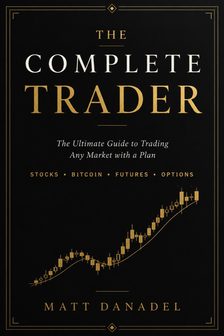
The Complete Trader$39.99
This article is the odds. The Complete Trader is for the reader who has seen them clearly and still wants the skill, and it is built in that order: its Chapter 1 is the survival arithmetic this article ran on real cohorts, and the sizing rules of Part 0 turn that arithmetic into positions no single day can end. Its own first page says most people who start trading lose money. What the book will not do is move you into the thin tail; nothing can promise that. It can only make sure that if your honest answer turns out to be no, the two-year filter charges you tuition instead of your future.
Questions, answered straight
Is the statistic that 90% of day traders lose money true?
As stated, it is folklore: the round 90% circulates with no traceable source. The measured numbers are not kinder, though. Taiwan's complete exchange records from 1992 to 2006 show the vast majority of day traders unprofitable in aggregate, and among Brazilians who day traded futures for 300 or more sessions, 97% lost money. The direction of the famous number is right; the number itself belongs to nobody.
How long do most day traders last?
Not long. In Taiwan's complete trading records, only 44% of new day traders were still at it a year after starting, 24% after two years, and 15% after three. More than three quarters quit within two years, and the unprofitable quit sooner than the profitable, which is the market delivering its answer and people accepting it.
Can you actually make a living day trading?
A tiny number of people do, and the records say to treat that outcome as the rarest one rather than the plan. In the Brazilian study that followed everyone who persisted for 300 or more sessions, 0.4% earned more than a bank teller, all while carrying real risk of loss. Living costs demand consistency, and consistency is precisely what the data shows almost nobody achieves.
Do any day traders reliably beat the market?
Yes, and honesty requires saying so. In the Taiwan data, roughly the top 500 traders of hundreds of thousands showed skill that persisted from year to year, earning profits even after fees. Fewer than 1% of the day trading population could do that predictably. The exception is real, measurable, and vanishingly rare, which is different from being a realistic default expectation.
The rest of this section
This guide covers the territory; these go deep on one question each.
Swing trading vs day trading: let your calendar decide
You are comparing the two as though the choice were yours. Your calendar already voted: one of them wants attendance at the hours your job owns.
How much money do you need to day trade? The rule and the real number
Three tabs, three confident answers, all quoting a $25,000 rule that is being retired while you read them. What limits an account now, and what never changed.
Paper trading vs real money: what the simulator cannot teach
Your practice account is up and you cannot tell whether that means anything. What a simulator teaches, what it cannot price, and how to switch across by size.
What is position sizing, and why does it decide everything?
Being right about the stock is not enough if you staked a third of the account on it. Size sets the price of being wrong, and being wrong is routine.
Stop losses: what they do, and what they do not
You set a stop at $46 and the shares sold at $41, with nothing malfunctioning. A stop is an instruction, not insurance, and the difference shows up once.
How long does it take to learn trading? Count in trades, not months
You are eight months in and feel behind a schedule nobody set. Real trading records say the unit of learning is trades placed, not months survived.
Keep reading
Everything here is education, not financial advice. How I source numbers and handle corrections: Editorial standards. The full risk language: Disclaimer.