Trading · The blog
Paper trading vs real money: what the simulator cannot teach
The short answer
Nick has not lost in three months. His practice account, the simulator his platform gave him free, is up about 40%, and the win rate on his little dashboard is the kind that real money managers retire on. He knows what a limit order does now. He can place a stop without looking up where the button is. And yet, sitting at the funding screen with his debit card in reach, he hesitates, because some honest part of him suspects the number on the dashboard is not entirely his. His hesitation deserves more respect than his dashboard, because this article is about what exactly his suspicion knows.
The question people type, paper trading versus real money, sounds like a choice between two products. It is really a question about what each one measures. A simulator measures your decisions against a market that cannot touch you. A live account measures your decisions and you, against a market that charges for everything. Those are different exams, the second one is the one that pays, and the gap between them is not a flaw in practice accounts. It is the entire reason they exist, and the reason they are free.
Two curriculums on the same screen
Say the honest half first, because the simulator’s reputation swings between miracle and scam, and it is neither. There is a real curriculum that paper trading teaches better than money does, precisely because mistakes cost nothing.
What each account can teach
The simulator
- Order types, until entering them is mechanical
- Reading a live market without paying for the seat
- Rehearsing a written plan, repetition by repetition
- Finding your setup in real time, at zero cost per miss
- Free mistakes, made early, when they are cheapest
Real money
- Real fills: the spread and the slip, charged every trade
- What losing feels like when the loss is yours
- Whether your rules survive contact with your fear
- Sizing decisions made while your pulse is involved
- The habit of following a plan when it costs something
Neither account replaces the other. The simulator teaches the trade; only money teaches the trader.
Everything mechanical belongs to the simulator. Which button, which order type, what a partial fill looks like, how fast a moving market moves: a beginner who pays real spreads to learn the interface is buying typing lessons at market prices. The rehearsal function matters even more. A written plan is a theory until you have executed it dozens of times, and the simulator is where following rules becomes a motor habit instead of a daily act of willpower. That much is real, and it is worth weeks of anyone’s time.
One feature of practice accounts deserves suspicion, though, and it is the reset button. Blow up a simulator and you can open a fresh one in a minute, and people do, routinely, which quietly curates every practice record that survives: the dashboards that get screenshotted are the ones that were not reset. A live account keeps its whole history, including the ugly first chapter, because money has no undo. If you have reset your simulator even once, the honest version of your practice record includes the account that no longer exists, and it is worth writing that down somewhere the dashboard cannot delete it.
It is also worth asking, once, why the simulator is free. Platforms are not charities; a practice account is the least expensive customer acquisition in finance, a showroom whose exit leads to the funding screen. That does not make it useless, any more than a test drive is useless. It means the product being sold is not practice. It is the account that comes after, which is a good thing to remember about every design choice that makes the practice feel effortless.
Practicing so the score means something
Since the simulator’s job is rehearsal, it pays to rehearse the show you intend to put on, and most people do not. The default practice account arrives loaded with a fantasy balance, a hundred thousand pretend dollars for a person who will eventually fund two thousand real ones, and every decision made at fantasy scale is a rehearsal for the wrong play. Set the practice balance to the money you would genuinely trade, and size every position by the rules you intend to live by, because a habit formed at fifty times your real size is not a habit. It is a costume.
The same goes for the conditions. Practice during the hours you will really trade, not the lunch breaks that happen to be convenient this month. Take every trade your written rules generate, not the ones that look promising, because cherry-picking in rehearsal builds exactly the improvisation the rehearsal exists to remove. And journal the pretend trades with the same fields you will use live: the setup, the plan, the result, the state of mind. A simulator run this way produces something rare, a practice record that means what it says. Run the default way, at fantasy scale, resettable, trades chosen by mood, it produces the dashboard Nick is rightly refusing to believe.
The flattery is measurable enough to be regulated
The trouble begins when the practice score gets read as a forecast, and here I can hand the argument to a regulator, because the flattery in simulated results is so well established that federal rules dictate a warning label for it. When professional commodity trading advisors advertise simulated performance, the CFTC’s advertising rule requires a prescribed disclaimer beside it, and its language is worth reading slowly, because it is a regulator’s own inventory of how paper profits mislead: “Unlike the results shown in an actual performance record, these results do not represent actual trading,” the required text runs, in part, and simulated programs “are also subject to the fact that they are designed with the benefit of hindsight.” It closes flatly: “No representation is being made that any account will or is likely to achieve profits or losses similar to these being shown.”
A rule written for professionals advertising to strangers applies word for word to the advertisement your own simulator is running at you. And one limitation belongs on the list that no disclaimer mentions: a simulator can only show you the market that happened while you were practicing. Three calm months of paper trading are three months of one kind of weather, and a plan validated entirely inside it has been tested against a single mood of a thing that has many. Practice cannot compress time, which is one more reason a practice record, however long it feels, is a small sample wearing a confident interface. The fills are the first flattery: a simulator grants you the price on the screen, while a live order pays the spread, the gap between buying and selling prices, and suffers slippage, the difference between the price you wanted and the one you got, which grows exactly when markets move fast. Small tolls, charged per trade, compound into the difference between a strategy that works on paper and one that breaks even in the world.
The academics who study real traders add a quieter problem. The Finnish researchers whose complete national records I drew on in the article on how long trading takes to learn noted that learning from hypothetical trades is hard for reasons beyond costs: it takes unusual discipline to track pretend trades honestly, and the prices at which they would really have filled are, in their word, not observable. A paper record is not just flattered. It is partly fiction, kept by an interested party, and the interested party is you.
The missing instructor is you
None of that is the deep reason practice champions stumble live, though. The deep reason has a fifty-year-old measurement behind it. In 1979, Daniel Kahneman and Amos Tversky published the paper that later helped win a Nobel prize, and its finding about losses is the single most relevant sentence in economics for a trader leaving the simulator: “A salient characteristic of attitudes to changes in welfare is that losses loom larger than gains. The aggravation that one experiences in losing a sum of money appears to be greater than the pleasure associated with gaining the same amount.”
Read that against Nick’s dashboard. On the simulator, a losing trade subtracts points; the plan says exit, and exiting costs nothing but score. Live, the same red number is aggravation, in Kahneman and Tversky’s word, and the aggravation outweighs the symmetric pleasure of winning. That asymmetry is what quietly rewrites live behavior: stops moved a little lower to avoid realizing the loss, winners sold instantly to lock the relief in, one oversized trade to win yesterday back. Nothing about the market changed. The person operating the plan did, because for the first time the plan was attached to a nervous system.
Why paper results flatter, per the record
| The flattery | Who documented it |
|---|---|
| Simulated results “do not represent actual trading” and carry hindsight's benefit | CFTC, required disclaimer, 17 CFR 4.41 |
| Hypothetical trades fill at prices that are “not observable”, tracked by an interested party | Seru, Shumway and Stoffman, Review of Financial Studies, 2010 |
| Real losses change the trader: “losses loom larger than gains” | Kahneman and Tversky, Econometrica, 1979 |
Simulated results “do not represent actual trading” and carry hindsight's benefit
Who documented itCFTC, required disclaimer, 17 CFR 4.41
Hypothetical trades fill at prices that are “not observable”, tracked by an interested party
Who documented itSeru, Shumway and Stoffman, Review of Financial Studies, 2010
Real losses change the trader: “losses loom larger than gains”
Who documented itKahneman and Tversky, Econometrica, 1979
The switch is a dial, not a leap
Notice what the question at the top of this article assumes. When to switch, paper trading versus real money: the language imagines a cliff, with practice on one side and a funded account on the other, and one dramatic day of jumping. The cliff does not exist. Between the simulator and the size you eventually intend to trade sits every size in between, and the bottom of that range, one share, the minimum contract, the smallest position your platform allows, is the most underrated classroom in trading. A one-share position pays real spreads, fills at real prices, and attaches your actual nervous system to an actual outcome, while pricing the whole lesson in pocket change. It is the only place where the second curriculum, the one about you, can be studied cheaply.
What the smallest click of the dial looks like depends on the market. In stocks it is a single share, or less where fractional shares exist. In futures it is one micro contract, a fraction of the standard size, built for exactly this. Whatever the instrument, the definition is the same: the smallest position where the fills, the costs and the feelings are real, chosen so that being completely wrong is an inexpensive lesson rather than an event.
So the honest sequence is not paper, then money. It is paper until the mechanical curriculum is finished, then the dial. Practice until your rules are written and a real sample of paper trades has tested them, not a lucky week, but enough repetitions that the plan, and not your improvisation, produced the record. Then go live at the smallest size that exists and change nothing else. Same market, same setup, same rules, same journal; the only new variable is that the money is real, which means the only new information in your results is information about you. If your one-share results track your paper results, the dial turns up a notch. If they do not, you have located the gap precisely, it cost almost nothing to find, and it is a gap no additional month of simulation was ever going to close. The staged version of exactly this crossing, two weeks on paper and then two at the smallest live size, is the thirty-day on-ramp Chapter 34 of The Complete Trader lays out.
That is also the honest answer to Nick, still at the funding screen with his 40%. The dashboard is not lying about his progress; it is lying about its own units. It says he has learned the market. It means he has learned the mechanics, which is real, finished, and worth exactly what it cost. The remaining education is the one the simulator was structurally unable to sell him at any price, the one where the aggravation is real and the fills are worse and the plan has to hold anyway. He should not skip it, and he should not fund it at full size either. He should turn the dial one click, trade one share, and meet the instructor.
Keep going
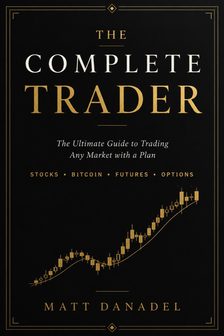
The Complete Trader$39.99
This article is about where practice ends. The Complete Trader is written for the crossing: Chapter 32 is the test-before-you-risk method the paper stage is meant to be, Chapter 34 stages the move to real money one small size at a time, and Chapter 6, the head game, is the honest treatment of the loss aversion that ambushes people on their first live afternoon. What the book cannot do is make that afternoon painless. The whole reason the crossing works is that the fear is finally real, and no chapter charges less for it than the market does.
Questions, answered straight
Is paper trading worth it?
Yes, for the job it can do. A simulator is the cheapest place on earth to learn order types, practice reading a live market, and rehearse a written plan until following it feels mechanical. Every mistake there is free, and beginners make their most expensive mistakes early. What it cannot do is predict your live results, and treating a good paper record as that prediction is the standard way it gets misused.
Why do I trade worse with real money than on paper?
Two reasons, one in the market and one in you. Real orders pay the spread and suffer slippage, costs a simulator quietly skips, so identical decisions score lower live. And real losses change your behavior: the research behind loss aversion found the pain of losing a sum outweighs the pleasure of gaining it, which is why plans that survive practice get abandoned the first live afternoon they are tested.
How long should you paper trade before going live?
Until your rules are written down and a real sample of trades has tested them, which is a count, not a duration. A week of ideal conditions proves nothing, and a simulator cannot even show you every condition. When the plan holds on paper, the honest next step is not a funded leap but the smallest live size your platform allows, which starts the half of the education paper cannot deliver.
Can you make money paper trading?
No. Simulated gains are score, not money, and they systematically overstate what the same decisions would have earned live. Federal rules require anyone advertising simulated results to say exactly that: the required disclaimer states that such results do not represent actual trading and are designed with the benefit of hindsight. Treat a paper profit as evidence about your process, never as a preview of income.
Keep reading
Everything here is education, not financial advice. How I source numbers and handle corrections: Editorial standards. The full risk language: Disclaimer.