Options · The blog
What are the Greeks, and which three do the real work?
The short answer
Lily did the hard part right. She researched a company, decided its earnings would beat expectations, bought a call the week before the report, and watched the stock rise the morning after the announcement. Her call lost a third of its value on the same news. Her afternoon is the single most common way options introduce themselves to careful people: the direction was right, the reward went missing, and every explanation she finds is a wall of Greek letters that seems designed to make the question go away.
Here is the honest version of what the Greeks actually are. An option’s price has several moving parts, not one, and the Greeks are simply the standing answers to the question Lily is actually asking: what just moved my premium? Each Greek names one force and measures it. Learn to read three of them and almost nothing an option does will surprise you again; ignore them and you are trading a five-input instrument with a one-input theory. This article defines all five, in order of how much they will matter to you, and then returns to Lily’s afternoon, because her loss was not bad luck. It was two named forces beating one.
Where the Greeks come from
The Greeks are not folklore; they fall out of arithmetic. In 1973, Fischer Black and Myron Scholes published the paper that gave markets their first standard model for pricing an option, and the model’s inputs are exactly five: the stock’s price, the strike, the time remaining, the expected volatility of the stock, and the interest rate. Once a price is a formula, you can ask how it responds when each input shifts, and those five sensitivities are the Greeks. Nothing mystical happened; they are just the model’s way of itemizing its own moving parts, and every trading platform since has computed them continuously beside each contract.
One naming quirk belongs here, because it is exactly the sort of thing a careful reader trips over and almost no page explains. Four of the five are genuine letters of the Greek alphabet: delta, gamma, theta and rho. Vega is not a Greek letter at all. The name was adopted by traders and stuck, which is why you will occasionally meet the same measure called kappa or tau, both of which are real letters. The collective name is a convention rather than an etymology, and nothing about what the measures do depends on it.
One honesty note before the definitions, supplied by the industry itself. The Options Industry Council, the education arm of the clearinghouse behind every listed contract, is careful to say that “Greeks are not a guarantee of exact option premium changes, but rather a theoretical guidepost that gives investors an estimate of an option’s value when the underlying moves, or if there are changes in one or more pricing components.” They are forecasts from a model, refreshed constantly, reliable in direction and approximate in size. Read them as instruments, not promises.
Five Greeks, five answers
| The Greek | The question it answers |
|---|---|
| Delta | If the stock moves $1, how much of that move is mine? |
| Gamma | How fast does my delta itself change as the stock moves? |
| Theta | What does one passing day take from my premium? |
| Vega | What does a shift in expected volatility do to my premium? |
| Rho | What does a change in interest rates do, mostly at long horizons? |
Delta
The question it answersIf the stock moves $1, how much of that move is mine?
Gamma
The question it answersHow fast does my delta itself change as the stock moves?
Theta
The question it answersWhat does one passing day take from my premium?
Vega
The question it answersWhat does a shift in expected volatility do to my premium?
Rho
The question it answersWhat does a change in interest rates do, mostly at long horizons?
Delta and gamma: your share of the move, and its fine print
Delta comes first because it quantifies the thing you bought the option for. The OIC’s definition is admirably plain: “Delta is a theoretical estimate of how much an option’s premium may change given a $1 move in the underlying.” A call with a delta of 0.50 gains about fifty cents of premium, per share, when the stock rises a dollar, and loses the same when it falls; multiply by the hundred-share contract and that dollar of stock movement moves the position about $50. Puts run the same logic with the sign flipped. Deltas live between 0 and 1 for calls, and traders use them as a rough measure of how substantial a claim on the stock’s movement they actually hold: a deep in-the-money call with 0.90 delta behaves almost like stock, and a far out-of-the-money one at 0.10 barely notices the stock at all, which is the honest reason the cheap ones are cheap.
Delta moonlights in a second job worth knowing about, because your platform’s interface probably assumes you do: traders read it as an approximate probability that the option finishes in the money. The 0.10-delta call is, loosely, a one-in-ten shot; the 0.50 at-the-money contract is a coin flip. The shorthand is genuinely useful for talking about how ambitious a strike is, and genuinely imperfect as mathematics, since it drifts with volatility and time in ways the casual version ignores. Treat it as a conversational unit, the way “a twenty-minute walk” describes distance, and it serves; treat it as a measured probability and it will eventually overcharge you for the difference.
Gamma is delta’s fine print: it measures how quickly delta itself changes as the stock moves. It answers a question you develop only after holding a position through a move: why did my option speed up? A call bought at 0.30 delta does not stay a 0.30-delta call as the stock rallies toward the strike; delta climbs as the move goes your way, each next dollar of stock movement is worth more to you than the last, and gamma is the rate of that climbing. For a beginner holding ordinary positions weeks from expiration, gamma is context rather than headline. Near expiration it becomes the headline: with almost no time left, small stock moves push an at-the-money option’s delta across huge stretches of its range in hours, which is a large part of why the shortest-dated contracts feel like a separate instrument even though every definition here still applies.
Theta: what the clock charges
An option is partly made of time. Days remaining are chances remaining, chances have value, and theta measures the slice of value that leaves as each day passes with everything else held still. If your platform shows a theta of −0.04, the model expects tomorrow’s version of your option, same stock price, same volatility, to be worth about four cents per share less than today’s, $4 per contract, simply for being one day shorter.
Two properties make theta the most practical Greek a buyer owns. It never sleeps and never helps you; a bought option pays the clock every single day, weekends included in effect, and only movement can outrun the meter. And it is not linear: the charge accelerates as expiration nears, gently in the far months, steeply in the final weeks.
What the clock takes, and when
That curve is why “I’ll give the trade a few more days” is an expensive sentence near expiration and a cheap one far from it, and why buyers who like sleeping choose longer dates while sellers of options are, structurally, people being paid to sit on the other side of the meter.
Vega: the Greek that got Lily
Vega measures the premium’s response to changes in expected volatility, and it is the one Greek that moves violently without the stock doing anything at all. The expected part is the key. An option’s price contains the market’s forecast of how much the stock is likely to swing before expiration; when that forecast rises, options get more valuable, because bigger swings mean better odds of finishing well. When the forecast falls, premium drains out.
Now watch it work on Lily’s week. Before earnings, uncertainty is the product: everyone knows a big move is possible, the volatility forecast inside her call’s price runs hot, and her $2.30 premium on the one-week $87.50 call, stock at $85, is substantially made of that heat, an illustration with round numbers but a faithful shape. The report lands, the uncertainty resolves, and the forecast collapses in minutes, taking its share of every option’s premium with it. Her stock’s polite rise to $86 pushed perhaps forty cents of delta value into the call while the volatility collapse pulled a dollar out, the clock took its own dime overnight, and the position settles near $1.60: direction right, premium down a third. Traders call the mechanism a volatility crush, and it is scheduled, not sneaky; the calendar of earnings dates publishes exactly when it will fire. Lily did not lose to bad luck. She bought expected turbulence at its annual maximum and watched it get repriced to calm, and no amount of being right about the company was budgeted to pay for that.
Rho, for completeness, measures sensitivity to interest rates, and at the expirations most readers trade it is a rounding error; it earns its keep on multi-year options and in professional books, which is why it sits last on every list including this one.
Reading them off the screen
A few practical conventions keep the numbers from lying to you on first contact. Platforms quote Greeks per share, like premiums, so a theta of −0.04 is four cents per share and $4 per day on the hundred-share contract; scale everything by 100 before it means anything in dollars. Signs describe your side: the Greeks flip when you sell. A sold call’s theta works for you and its delta against you, which is the entire premise of every income strategy compressed into two sign changes. The numbers are also alive, recomputed as the stock moves, the clock runs, and the volatility forecast shifts, so the delta you bought is not the delta you hold a week later. And on any position with more than one leg, the platform’s totals row is the one that matters: a spread’s Greeks are the sum of its parts, and reading one leg in isolation is how people convince themselves a hedged position is either safer or riskier than it is.
Reading the three that do the work
Put the survivors in one sentence each. Delta is your share of the stock’s move. Theta is what the calendar charges you to keep that share alive. Vega is your exposure to the market changing its mind about how wild the future is. A beginner who checks those three numbers before entering, and understands that all three are always running at once, has more working knowledge than most of the people posting payoff screenshots, because the screenshots show one force and positions live under five. The roster does shift with style, which is worth saying honestly: traders working the shortest expirations promote gamma into the working set, because near the deadline it grows loud, and sellers spend their careers watching theta and vega from the other side. But for a buyer at ordinary tenors, the three above are the day shift, and the other two are specialists you will meet when your positions give you a reason to.
What this article deliberately does not teach is the working gears underneath: where the probability shorthand comes from and exactly when it misleads, what gamma does to positions in the final week and how professionals size around it, what actually sets the volatility forecast that vega prices, and how the five interact inside spreads, where one leg’s theta pays another’s. That is a real curriculum, it is sequenced, and it is Part 3 of The Complete Guide to Options Trading, five chapters, one per Greek, each built on worked numbers you can recompute yourself. This article is the map’s legend. The book is the terrain.
Keep going
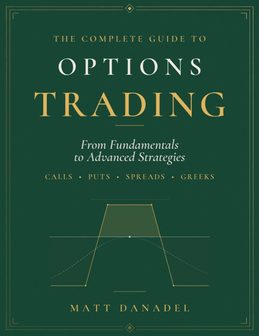
The Complete Guide to Options Trading$99.99
This article named the forces; the book teaches you to fly by them. Part 3 of The Complete Guide to Options Trading gives each Greek its own chapter with worked numbers, then Chapter 20 assembles them into the view a professional desk actually watches. And Chapter 22 covers the exact trap that caught Lily, the pre-earnings volatility crush, with the tools to see it priced in before you pay for it. None of it requires more math than multiplication. All of it requires more than one page.
Questions, answered straight
What does delta mean in options?
Delta estimates how much an option's premium changes when the stock moves one dollar. The industry's education council defines it exactly that way: a contract with a delta of 0.50 is expected to gain or lose about fifty cents of premium per dollar of stock movement. Calls carry positive delta, puts negative. Traders also lean on delta as a rough, imperfect shorthand for the market's odds that an option finishes in the money.
What is theta decay in simple terms?
Theta is the amount an option's value falls as one day passes with everything else unchanged. An option is partly made of time: the more days remain, the more chances the stock has to make the right move, so each passing day removes a slice of value. The removal is not steady. It accelerates as expiration approaches, which is why the final weeks of an option's life are the most expensive ones to sit through hoping.
Why did my option lose money when the stock went up?
Usually one of two Greeks outran your delta. If time passed without much movement, theta was quietly subtracting while the stock added, and small rises can lose to the clock. Around news events the culprit is vega: premiums inflate with expected turbulence before an announcement, and once the event passes, that expectation collapses and takes premium with it, sometimes faster than a favorable move can replace it. Direction is one input among several, not the whole price.
Do I need to calculate the Greeks myself?
No. Every serious broker platform displays them beside each contract, computed from a pricing model in real time. Your job is reading, not arithmetic: knowing what each number claims about your position, which ones dominate at your expiration date, and how they change as the stock moves and days pass. The calculation is the machine's work. Knowing what the machine is warning you about is yours.
Keep reading
Everything here is education, not financial advice. How I source numbers and handle corrections: Editorial standards. The full risk language: Disclaimer.