Trading · The blog
How long does it take to learn trading? Count in trades, not months
The short answer
Henry has been at this for eight months. He traded on a simulator for the first two, went live with the smallest size his platform allows, and has kept a journal the whole way, which is more discipline than most beginners ever assemble. His account is down a little. Not dramatically, just persistently, the way a phone battery drains. What bothers him is not the balance, though. It is the video he watched last night, in which a man about his age described reaching consistent profitability in ninety days, and the quiet arithmetic that followed: if that man needed three months, then eight months of not being there must say something about Henry. He has started to suspect he is behind schedule.
His schedule problem is the common one: nearly everyone who tries this carries a private deadline, assembled out of videos, forum posts and course advertisements, and measures themselves against it in the dark. So let me say the plainest thing first: there is no schedule. No researcher who has studied real traders has ever produced one. The deadline Henry is behind was written by people with something to sell him, and the honest answer to the question turns out to be stranger and more useful than any number of months.
The stakes are not academic. The timeline you believe controls real decisions: how much money funds the account, how long you persist after losses, whether a paid course looks like a shortcut worth buying, whether a job looks worth leaving. Believe a fast timeline and every ordinary month of learning reads as personal failure, which is precisely the state of mind expensive products are sold to. So I want to do two things here: show you where the fast timelines come from, and then show you what the only complete records of real traders learning say instead.
The schedule you feel behind was written to sell you something
The supply chain for trading deadlines is not a mystery. It shows up, regularly, in federal enforcement records.
In one case from 2022, the Federal Trade Commission forced a day trading education firm to pay millions of dollars back to its customers. The firm had sold its courses on the promise of verified profits earned part time, on a schedule measured in weeks. When the agency examined what had happened inside customers’ actual trading accounts, it found that most of those customers lost money, some of them thousands of dollars on top of the thousands they had paid for the training, and the settlement money went back out as refunds to more than twenty thousand people. The order also barred the firm from claiming that its customers could succeed regardless of their background, the capital they bring, or the time they can give it. Read that list twice: background, capital, time. It is a regulator’s inventory of exactly the variables a timeline promise has to erase before it can exist.
Nothing about the case is unusual except that it produced a court order. The FTC’s standing guidance on investment scams describes the whole species rather than one specimen: training pitches built around a “patented,” “tested,” or “proven” strategy, testimonials about quitting your job, and this flat sentence about the promises themselves: “Only scammers will guarantee that you’ll make over-the-top-profits, earn enough income to quit your job, or beat the stock market.”
I am not telling you this because any one company is uniquely wicked. I am telling it because it shows the incentive structure behind every fast timeline you will ever hear. A seller’s answer to “how long does this take” is not a measurement. It is a price tag, and the shorter it sounds, the more people enroll. The people who actually measure traders, with no course to sell, have published very different arithmetic, and it is worth seeing what they found.
What a complete national record of learning shows
In Finland, every share of stock held by every individual sits in a central register, so researchers do not have to survey traders or sample one brokerage’s customers. They can watch the entire country trade. Amit Seru, Tyler Shumway and Noah Stoffman used that register to follow every trade placed by Finnish individuals from 1995 through 2003, more than 22 million of them, for a paper in the Review of Financial Studies titled, aptly for the question here, “Learning by Trading.”
Their central finding rearranges the question. “We find evidence of two types of learning,” the authors write: “some investors become better at trading with experience, while others stop trading after realizing that their ability is poor.” Learning to trade and learning about yourself as a trader are two different educations, running at the same time, and the second one does much of the measurable work. Hold that thought, because I will come back to it.
For the first kind, the improvement kind, the paper’s most useful result is about units. When the researchers measured experience the way everyone instinctively does, in years since a person started, improvement was, in their word, negligible. When they measured it in trades placed, a real effect appeared: each additional 100 trades was associated with returns roughly 3.6 basis points higher over the following month, which is about three tenths of a percent per year. A basis point is one hundredth of one percent. The lesson sits in the contrast: “individuals actually have to place trades to learn,” as the paper puts it. Time in the market’s presence teaches almost nothing. Decisions, made and owned and reviewed, teach a little each.
What predicted improvement, and what did not
| How experience was measured | Measured effect on returns |
|---|---|
| Years since the trader began | Negligible improvement |
| Each additional 100 placed trades | Roughly 3.6 basis points a month higher |
| Raw averages, ignoring who quit | Overstate the learning rate 2 to 4 times |
Years since the trader began
Measured effect on returnsNegligible improvement
Each additional 100 placed trades
Measured effect on returnsRoughly 3.6 basis points a month higher
Raw averages, ignoring who quit
Measured effect on returnsOverstate the learning rate 2 to 4 times
That third row is the one that explains your social media feed. If you calculate how fast traders improve without accounting for the ones who left, you get a number two to four times too generous, because the strugglers keep exiting the sample and the survivors’ progress gets mistaken for everyone’s. The paper states it directly: “By ignoring investor attrition, the existing literature significantly overestimates how quickly investors become better at trading.” What is true of academic estimates is true of your feed, which performs the same distortion socially. The people still posting in year three are not evidence of what year three delivers. They are what is left after most of the cohort has gone quiet.
Why the calendar itself misleads
Even converted into trades, the ledger is missing something, because not all stretches of market teach the same lesson. A trader’s first year might be spent entirely inside a rising market, or a falling one, or a sideways grind, and skill demonstrated in one has a way of evaporating in the next. The Finnish researchers found a version of this in the data: investors learn less about their own ability in years when the market is rising, because a good year pays nearly everyone, and a reward that arrives regardless of skill carries no information about skill. A bull market is, in the most literal sense, a bad teacher. It grades generously and teaches you the wrong thing about yourself.
The other missing piece is noise. Early trading results carry very little information in either direction, because costs, luck and small samples dominate everything a beginner does. I walked through the complete outcome records behind that statement, from two national markets, in this section’s longer post on what happens to most people who try day trading; the short version is that months of results can look decisively good or decisively bad while meaning neither. The practical consequence for a learner is uncomfortable but freeing: for a long time, your account balance is not your report card. The only early feedback worth trusting is whether you followed rules you wrote down, which is a thing you can grade honestly after every single trade.
This is also the honest version of the full-time versus part-time question that every page on this subject answers with invented month counts. Hours do matter, but not because the calendar rewards attendance. They matter because someone at the screen every day accumulates decisions, and the reviews of those decisions, several times faster than someone trading around a job. Same tuition, different installment plan. The unit being purchased does not change.
The other graduation
Now return to the second kind of learning, the one the Finnish paper found doing much of the work: people discovering their own ability and acting on the discovery. In their records, an investor whose results ran one standard deviation below average was about 15% less likely to keep trading. The researchers’ point is that this is not the failure case. It is learning, functioning exactly as designed. The complete Taiwan day trading records behind a companion line of research by Barber, Lee, Liu, Odean and Zhang show the same process at population scale: 44% of new day traders still at it after one year, 24% after two, 15% after three, with the unprofitable leaving soonest.
The Finnish records also put a shape on how brief most of these educations turn out to be, and it is briefer than anything in the marketing, in either direction.
How long the typical trading education lasts
Three trades. That is the entire trading career of the median person who ever started one, in a complete national record. Most people do not grind through two years of losses before concluding this is not for them; they touch the stove, learn something true, and put the money back to work somewhere calmer. Which means the dramatic timeline question this article began with belongs to a minority to begin with: the people who stay long enough for a timeline to exist.
I think this reframe is the kindest true thing on this subject. The question “how long does it take to learn trading” quietly assumes one destination, profitability, and one failure mode, giving up. The measured reality is that this education has two graduations. Some students learn the market. Rather more learn themselves, at small cost if they managed the experiment well, and walk away with an answer that is worth actual money for the rest of their lives: every dollar they would otherwise have spent rediscovering it. A person who runs an honest six-month experiment, at small size, and concludes on the evidence that this is not their game has not failed a course. They have passed a cheaper one.
What you control is the price per lesson
If learning is denominated in trades, and the improvement per trade is small, and a meaningful share of students will graduate into the second outcome, then the practical question stops being “how do I go faster” and becomes “how do I make each lesson cost less.” That variable, unlike the timeline, is genuinely yours. A decision reviewed in a simulator costs nothing. The same decision at the smallest live size your platform allows costs pocket change and teaches more, because the discomfort is finally real. The same decision at full size costs whatever the market decides. Every lesson on the syllabus will be delivered either way; the tuition is negotiable and the sticker price negotiates against you.
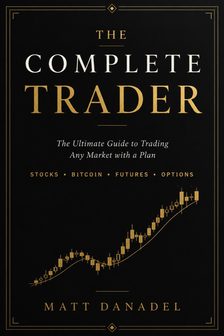
The instrument that does the converting, from trades merely placed into trades actually learned from, is a written plan and a journal, graded after every session. Placed trades are the raw material of the Finnish result, but a decision you cannot reconstruct afterward is a lesson delivered to nobody. Chapter 31 of The Complete Trader is where the book builds that journal, down to the fields a weekly review can actually learn from.
So the literal answer to the search that brought you here, assembled from records rather than from anyone’s marketing: the unit is years, not weeks, and the years are only a container. What fills them is some hundreds of decisions, made at survivable size and reviewed against written rules, through more than one kind of market, with the understanding that the improvement per decision is measured in basis points and that one of the two honest outcomes is discovering the game is not yours. Nobody can sell you a shorter version, though the record shows they will offer.
Which is the answer Henry was missing. He is not behind schedule, because there is no schedule; there is a count, and his is barely started. Eight months in, journaling, at minimum size, slightly down and still solvent, he is not failing his apprenticeship. He is paying for it at the lowest rate available, which is the only part he was ever in charge of.
Keep going
The Complete Trader$39.99
This article can tell you the timeline is a count, not a calendar. The Complete Trader is built to make the count worth something: Chapter 31 turns each trade into a journal entry a later self can actually learn from, Chapter 32 is the test-before-you-risk habit that keeps the early reps cheap, and Chapter 34 spends a first thirty days deliberately instead of at random. What the book will not hand you is a number of weeks. It cannot, honestly, and any chapter that promised one would be the chapter to distrust.
Questions, answered straight
Can you learn trading in three months?
You can learn the mechanics in three months: order types, chart reading, what a stop loss does. The measured records say skill is a different object. In the complete Finnish trading data, improvement tracked the number of trades placed rather than time passed, and it was small per trade. Three months also shows you only one kind of market. Treat three-month fluency as vocabulary, not competence.
Do trading courses make you profitable faster?
No measured evidence supports it, and enforcement actions point the other way: the FTC has forced day trading education firms to refund customers millions of dollars after finding that most of the people who bought the fast-profit promise lost money trading. A course or a book can compress vocabulary and spare you unstructured guessing. Nothing can compress the placed, reviewed trades that the records say learning is made of.
How do I know if I am improving at trading?
Count reviewed trades against a written plan, not months elapsed or the account balance. Early results are mostly noise in both directions, so a small sample proves nothing about you. Improvement shows up as rule-following first and profit later. If you cannot say how many trades your rules have been tested across, you do not yet have enough information to judge yourself, favorably or otherwise.
When should you give up on trading?
Decide before you start: a sample of trades and a dollar budget, both written down. Reaching either limit without progress is the experiment concluding, not you failing. The Finnish records show that much of what statisticians can measure as learning is people discovering their own ability and stopping. Quitting on evidence, after a real sample at small size, is the education having worked. It is one of the two ways this course of study ends.
Keep reading
Everything here is education, not financial advice. How I source numbers and handle corrections: Editorial standards. The full risk language: Disclaimer.