Options · The blog
What "most options expire worthless" actually means
The short answer
The pitch found Steve in the break room, from a colleague who trades: sell options instead of buying them, because 90% of options expire worthless, so nine times out of ten the seller just keeps the money. Be the casino, not the gambler. Versions of that pitch have been circulating for as long as listed options have existed, because it is a nearly perfect piece of persuasion. It contains one number, the number sounds official, and the conclusion writes itself.
The number is wrong, and this article is about the more interesting fact that its wrongness is documented by the options industry itself, in public, and the pitch survives anyway. Checking it takes one citation. Understanding what the true numbers do and do not say takes a little longer, and repays the time, because both the people repeating the myth and many of the people debunking it are misreading what a count of expired contracts can even tell you.
The industry’s own count
The Options Industry Council is the investor-education arm of the Options Clearing Corporation, the clearinghouse that stands behind every listed options contract in the United States, which makes it as close to the source as this statistic gets. Its own FAQ states the split plainly: “Historically, more than 72% of all option contracts are closed out in the market prior to expiration,” while “another 22% expire without value while the remaining 6% get exercised.”
How listed option contracts actually end
Published counts from other eras move these numbers a few points; older figures put closures nearer 55 to 70% and worthless expiries closer to a third. No credible accounting has ever put worthless expiries anywhere near 90%, and the shape never changes: the modal fate of an options contract is to be sold or bought back mid-life, exercise is rare, and expiring worthless is a solid minority outcome. Most options do not die at their desks. They retire early.
What “worthless” technically is, before anything else
The phrase has a precise meaning worth pinning down, because half the myth’s power is that it sounds like a verdict when it is really a bookkeeping category. An option expires worthless when it reaches its expiration out of the money, meaning the right it grants, to buy above the market or sell below it, is not worth using on its final day. The industry’s required disclosure document says what happens next without a gram of drama: “If an option has not been exercised prior to its expiration, it ceases to exist — that is, the option holder no longer has any rights, and the option no longer has any value.”
The boundary between that fate and exercise is thinner than most beginners imagine: one cent. Under the clearing system’s exercise-by-exception procedure, the OCC exercises expiring equity and index options that finish in the money by $0.01 or more per contract unless instructions arrive saying otherwise, which is why the same OIC page warns, in capital letters, that customers should give their broker explicit instructions to exercise or not exercise any expiring contract. A stock that closes a penny past the strike converts holders into shareholders overnight; a penny short, and the contract joins the worthless column. The category the myth treats as a moral outcome is, at the boundary, a rounding event.
That penny matters to the statistic’s meaning in one more way. Whether an option finishes one cent out of the money or five dollars out, it lands in the same 22%, and the count treats a near miss and a joke contract identically. A census with a one-cent boundary and no memory of how anyone got there is thin material for a philosophy of trading, which has never stopped anyone from building one on it.
Where the 90% came from, and the arithmetic it skips
The myth is not an invention from nothing; it is a misreading with a traceable shape. The real statistic that circulates alongside it says that only around 6 to 10% of options are exercised, and the myth is what happens when someone subtracts that from 100 and calls everything else worthless. The subtraction only works if you forget that closing a position exists, which is like computing divorce rates by assuming every marriage that did not end in a funeral ended in court. The largest category, contracts closed in the market, simply vanishes from the arithmetic, and it happens to be the category where most of the market’s wins and losses are actually realized.
Three sentences that sound alike
| The sentence | What it actually is |
|---|---|
| "90% of options expire worthless" | Folklore. No organisation publishes this figure; it survives because it sells a conclusion |
| "Only about 6 to 10% of options are exercised" | Real, and the misread parent of the myth: it says nothing about the unexercised majority |
| "22% of contracts expire without value" | The industry's own current accounting, alongside 72% closed early and 6% exercised |
"90% of options expire worthless"
What it actually isFolklore. No organisation publishes this figure; it survives because it sells a conclusion
"Only about 6 to 10% of options are exercised"
What it actually isReal, and the misread parent of the myth: it says nothing about the unexercised majority
"22% of contracts expire without value"
What it actually isThe industry's own current accounting, alongside 72% closed early and 6% exercised
It is worth pausing on why this particular myth is armored against correction. It flatters the listener twice. Believing it makes you feel smarter than the crowd of losing buyers, and acting on it requires no skill, just a willingness to collect premiums. A statistic that hands you both superiority and a shortcut will outrun its own debunking indefinitely, which is why the myth is still the headline claim of premium-selling pitches decades after anyone could check it in one search.
What even the true number cannot tell you
Here is the part the debunkings usually skip, and it matters more than the correction. Suppose the count were worse; suppose 22% were 40. What would it prove about who makes money? Almost nothing, for two reasons that generalize far beyond options.
The first is selection. Contracts that reach expiration are not a sample of all contracts; they are the residue after everyone with a reason to act already acted. In-the-money options get closed or exercised precisely because they are worth something, and holders of clearly dead options often abandon them because closing would cost more in commissions than the pennies returned. The expiration bin fills with contracts nobody wanted to touch, and then the myth reads the bin as a verdict on the whole market. The bin is not a scoreboard. It is a lost-and-found, and judging options trading by what expires is judging an airport by its unclaimed luggage.
The second reason is that endings are not journeys. Take a seller’s dream trade: a call sold for $1.10 that expires worthless. The statistic scores it a win and moves on. Now add the middle of the story: six weeks in, a rally put that call at $4.00, the seller sat on a paper loss of nearly three times the premium collected, faced a margin call’s polite cousin in the form of rising buying-power requirements, and held on. The ending was profitable; the journey nearly wasn’t; and a trader with slightly less nerve, or slightly more size, exits that identical trade at a large loss and never appears in the worthless-expiry column at all. Multiply that by every spread whose expired leg was half of a losing whole, and you see the deeper problem: a count of contract endings cannot be converted into a count of trader outcomes, in either direction. Sellers really do win often and small while carrying the risk of rare large losses; buyers really do lose often and small while holding the rare large win. The expiry census is silent about all of it.
The statistic is also aging badly underneath everyone quoting it, because the market it describes has changed shape. The OIC’s split describes the historical population of contracts, most of which had weeks or months to live and plenty of time to be closed mid-life. The market’s growth since has come overwhelmingly from the other end of the calendar: by Cboe’s count, same-day contracts made up 59% of S&P 500 index option volume in 2025, and a contract born at 9:30 that dies at 4:00 has hours, not weeks, in which “closed before expiration” can happen. Whatever the ending statistics of the daily-expiry era turn out to be, they will describe a different animal underneath the same word, and anyone quoting a fixed percentage of options that expire worthless owes you the answer to a question almost nobody asks the pitch: options from which era, measured by whom?
And expiration itself is stranger territory than the myth imagines, one more reason to treat the day as a subject rather than a formality. Finance researchers studying it found that on expiration dates, the closing prices of stocks with listed options cluster measurably at option strike prices, with optionable stocks’ returns altered by an average of at least 16.5 basis points that day; the study, published in the Journal of Financial Economics in 2005, attributes the pull to market makers’ hedge rebalancing and some deliberate price manipulation. The finish line is not even a neutral piece of tape. It bends the race.
What to do with the corrected number
Strip the myth and be careful not to fall into its mirror image, because the rebuttal has a failure mode of its own. A beginner who learns that most options are closed early sometimes concludes that expiring worthless is rare enough to ignore, holds every bought option to the bell hoping, and discovers that a contract does not need to reach expiration for its value to leave; an out-of-the-money option bleeds worth continuously as its deadline approaches, and the 22% who attend the funeral are simply the ones who stayed for the whole service. The 72% who closed early include most of the market’s realized wins, and also most of its sensible surrenders.
The true split, read correctly, tells a beginner three practical things. Most positions end by choice, in the market, which means managing a trade mid-life is the normal skill of this activity, not an advanced one. The exercise machinery fires rarely, but when it fires it is real, and short positions can be assigned, which is why expiration week deserves respect rather than fear. And nobody collects money for free at either desk: buyer and seller hold the same fairly priced bet in two different rhythms, and neither rhythm is an edge.
What the corrected number cannot do is teach you the machinery it summarizes: what actually happens on the final day, how assignment lands in an account, when closing early is right and when it is a habit that leaks money. That is mechanics, it is learnable, and it is exactly what Chapter 7 of The Complete Guide to Options Trading exists to teach, down to the final hour. Steve does not need to distrust his colleague; he needs the arithmetic the pitch was hoping he would never see, and now he has it.
Keep going
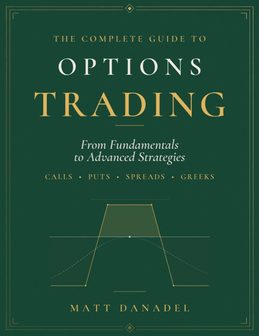
The Complete Guide to Options Trading$99.99
This article corrected the statistic; the book teaches the machine it mismeasures. Chapter 7 of The Complete Guide to Options Trading walks the entire finish line: exercise, assignment, the final trading hour, and the cases where letting a contract expire is right. Chapter 9 then shows, with one table, why a seller's high win rate and a fair price can coexist, which is the honest core the 90% pitch is a cartoon of. Neither chapter will hand you the casino's chair. They will show you why nobody is sitting in it.
Questions, answered straight
What percentage of options actually expire worthless?
The Options Industry Council, the education arm of the Options Clearing Corporation, states that historically more than 72% of option contracts are closed in the market before expiration, about 22% expire without value, and the remaining 6% are exercised. Published figures from earlier eras vary a few points in each direction, but every credible count agrees on the shape: closing early is the majority outcome, and expiring worthless is a minority one.
Does an option expiring worthless mean the seller made money?
Not by itself. The expiry tells you the contract's last day, not the position's life. A seller may have bought the option back earlier at a loss, sold it as one leg of a spread whose other leg lost more, or carried terrifying paper losses in between. Worthless expiry means the buyer's remaining right ended with no value, and that is all it means. Profit and loss are properties of positions over time, not of the final bell.
Why do sellers quote the 90% statistic so often?
Because it makes selling options sound like owning a casino, and it recruits. The honest version is less magnetic: a minority of contracts expire worthless, the seller's comfortable win rate is purchased by accepting rare losses large enough to matter, and fairly priced premiums give neither side a built-in edge. Any pitch resting on the 90% figure has failed a checkable fact before asking for your money, which tells you something useful about the pitch.
Should I let my options expire or close them?
Decide by what the position still holds, not by habit. An option with meaningful value left is usually closed, capturing what remains; an option worth pennies may cost more to close than it returns, and many traders let those expire. Short positions carry an extra consideration: an option that finishes in the money can be exercised against you, so sellers who do not want assignment close before the final bell. The mechanics of that finish line deserve learning before your first expiration, not during it.
Keep reading
Everything here is education, not financial advice. How I source numbers and handle corrections: Editorial standards. The full risk language: Disclaimer.