Options · The blog
Is options trading gambling? Where the line actually runs
The short answer
When Taiwan’s national lottery jackpot climbs past 500 million Taiwan dollars, stock trading in Taipei measurably thins. Two finance researchers, Xiaohui Gao and Tse-Chun Lin, watched it happen across years of repeated jackpots in the complete records of Taiwan’s market: in big-jackpot periods, trading volume in the stocks individual investors favor fell by 5.2 to 9.1%, and the drop concentrated exactly where a gambling appetite would live, in lottery-like stocks and, notably for this article, in options with the most sensitivity to volatility. The same dollars, the same weeks, moving between a lottery ticket and a brokerage order as if the two products were shelved side by side.
For some of the people in that data, they are. That is the fact this whole question turns on, and it is worth more than every reassuring blog post ever written on the subject. Whether options trading is gambling sounds like a debate about definitions, and most of what is written about it treats it that way, which lets everyone go home with the answer they came for. But gambling is not a definition. It is a behavior, it leaves fingerprints in data, and researchers have gotten very good at finding them inside ordinary brokerage accounts. So this article can do something more useful than argue. It can show you the measurements, and then show you exactly where the line runs, because it does run somewhere, and knowing where has real money attached to it.
The gambling dollar is visible in motion
Start with what the Taiwan result actually establishes, because it is stranger and more useful than it first looks. Gao and Lin’s paper is titled “Do Individual Investors Treat Trading as a Fun and Exciting Gambling Activity?”, and their method answers it without asking anyone’s opinion: if trading scratches the same itch as a lottery ticket for some people, then a sudden, giant lottery prize should pull money out of the market. It does, repeatedly, by measurable percentages. Their abstract states the finding in one sentence: “When the jackpots exceed 500 million Taiwan dollars, the trading volume decreases between 5.2% and 9.1% among stocks preferred by individual investors.”
The pattern is not Taiwanese. Alok Kumar, working through the records of roughly 70,000 accounts at a large US discount broker, documented the same appetite from the other direction in a 2009 Journal of Finance study: individual investors, unlike institutions, gravitate toward stocks built like lottery tickets, cheap, volatile, with a small chance of a huge payoff, and the same socioeconomic groups that spend the most on actual lotteries hold the most of them. The preference is expensive: the stronger an investor’s taste for lottery-shaped stocks, the worse their returns ran. Gambling inside markets, in other words, is not an insult traders throw at each other. It is a measured investor behavior with a demographic profile, a price tag, and a substitute product at the gas station counter.
Gambling, measured inside markets
| What was measured | The finding |
|---|---|
| Taiwan's stock market during lottery jackpots over NT$500 million | Trading volume fell 5.2 to 9.1% in the stocks individuals favor; volatility-sensitive options traded less too |
| Roughly 70,000 US brokerage accounts, who holds lottery-like stocks | The same groups that spend most on lotteries, and the stronger the preference, the worse the returns |
| US retail options orders isolated in transaction data, Nov 2019 to Jun 2021 | Lost $2.1 billion in aggregate; half the trades had under a week to expiry |
| Share of S&P 500 index option volume expiring the same day, 2025 | 59%, averaging 2.3 million contracts a day |
Taiwan's stock market during lottery jackpots over NT$500 million
The findingTrading volume fell 5.2 to 9.1% in the stocks individuals favor; volatility-sensitive options traded less too
Roughly 70,000 US brokerage accounts, who holds lottery-like stocks
The findingThe same groups that spend most on lotteries, and the stronger the preference, the worse the returns
US retail options orders isolated in transaction data, Nov 2019 to Jun 2021
The findingLost $2.1 billion in aggregate; half the trades had under a week to expiry
Share of S&P 500 index option volume expiring the same day, 2025
The finding59%, averaging 2.3 million contracts a day
Notice what this evidence does to the usual argument. Both camps on this question, the brokers insisting options are a legitimate tool and the worried relatives insisting they are a casino, are arguing about the instrument. The data quietly changes the subject to the person holding it, which is where the answer actually lives.
Why “it takes skill” settles nothing
The standard defense, and it appears nearly everywhere the question is asked, goes: gambling is luck, trading is skill and analysis, therefore trading is not gambling. I am not going to hand you that one, because it does not survive a minute of contact with the real world. Poker takes enormous skill and is gambling. Sports bettors run models that would impress a quant desk and are gambling. The presence of analysis has never once moved an activity out of the gambling column, and a beginner who accepts the skill defense has been handed a permission slip, not an answer.
What actually separates the two is the job the money is doing. Gambling, stripped of moralizing, is staking money on an uncertain outcome for the appeal of the stake itself, where the expected result of repeating it is a loss and the loss is the price of the entertainment. Nobody buys a lottery ticket as a savings plan. The ticket is the product.
Set that against what an option is underneath, which is a machine for moving a specific risk from someone who does not want it to someone who is paid to carry it. A fund manager holding a concentrated stock position through a nervous quarter buys a put the way a homeowner buys a fire policy: the premium will probably be lost, and that is fine, because the worst case was the thing being paid to remove. Uncertainty is present, money is staked, and yet the position runs in exactly the opposite direction from a gamble. The buyer paid to have less risk, not more. An instrument that can do that is not a slot machine, whatever its worst users do with it.
Both of those descriptions are true at once, and that is the point. The same contract, on two different desks, is a fire policy and a lottery ticket. Which one it is on your desk is decided by three things the contract itself cannot see: why you entered, what losing would do to you, and whether the price you paid had a reason behind it. That is where the line runs. Not between options and stocks, not between fast money and slow money. Between positions that are hired for a job and stakes that are the entertainment.
The corner of the market on the gambling schedule
If the line runs through behavior, you would expect the market to grow a corner shaped for the gambling side of it, because markets grow toward demand. It has. A same-day option, usually called 0DTE for zero days to expiration, is a contract on its final day of life: cheap, explosive, and settled by dinnertime. In Cboe’s own accounting of 2025, “Zero days to expiry (0DTE) SPX options averaged 2.3 million contracts daily and comprised 59% of the product’s total volume.” Read that figure again, because of what it describes: the majority of trading in the most important option product in the world sat in contracts that expire the day they are bought.
Same-day resolution matters because speed is not a neutral feature. The engine of every gambling product is a short loop between stake and result, run again and again; slot machines are engineered around it, and the gambling-addiction literature treats loop speed as a core risk factor. A contract that settles in hours runs that loop faster than any instrument a retail investor has ever been offered, and the apps delivering it have been redesigned around the same principle. The UK’s Financial Conduct Authority, one of the few regulators to study trading apps directly, ran an experiment on over 9,000 consumers and found that push notifications and prize-draw features increased the number of trades placed by 11 and 12% and tilted trades toward riskier products. Their conclusion from the research is about as direct as regulators get: “We are also concerned that the app features may blur the lines between online investing and gambling-like behaviours.”
The FCA did something else in that research that nobody selling options courses will ever do: it gave trading-app users the standard clinical screen for gambling problems, the same questionnaire used to assess casino patrons.
Trading-app users, screened for gambling problems
One in twenty-seven, on the clinical screen, among ordinary app investors, before anyone opened an options chain. The participants themselves saw it without prompting: one told the FCA’s researchers the design felt “all very in your face and feels more like a sports betting app.” When users and regulator agree on the resemblance, the resemblance is not a metaphor.
And the bill for the gambling side of the line has been added up, in American accounts, by researchers who could see the individual trades. Svetlana Bryzgalova, Anna Pavlova and Taisiya Sikorskaya isolated retail options orders inside transaction-level data and priced the whole cohort’s results in a 2023 Journal of Finance study: retail investors as a group lost $2.1 billion between November 2019 and June 2021. What makes that number worth more than its size is where it went. Visible commissions came to roughly $900 million. The invisible cost, the distance between the price a retail order actually received and the midpoint of the quote, came to what the authors call “a staggering $6.4 billion.” Their single-sentence summary of the behavior explains why: retail investors “prefer cheaper, weekly options with average bid-ask spread of 12.6%, and lose money on average.” Half the retail trades in their sample had less than a week left to run. That is not a portfolio being managed. It is a ticket being bought, on a product advertised at zero commission whose quoted spread averages one dollar in every eight.
Research on individual trades points the same way: the studies covered in the guide to what options are actually for found retail options buyers losing 5 to 14% of the amounts they invested around earnings announcements, with the market makers’ spread collecting throughout.
An honest test you can run on yourself
None of those numbers convict you personally, and this site does not do guilt by instrument. What the evidence supports is narrower and more useful: gambling with options is common, expensive, industrially encouraged, and invisible from the inside, because it wears the same interface as the careful version. So the useful move is not a verdict about options trading. It is a test you can run on your own next trade, built from the three things that actually place a position on the map.
First, the job. Say out loud what this position is hired to do, protection, income against shares you hold, or a bounded bet on a thesis, and notice whether the sentence embarrasses you. Second, the worst case: a number you wrote down before entering, sized so that hitting it changes nothing about your month. Third, the price: a reason to believe the contract is mispriced, which is a claim about the seller’s estimate being wrong, not a feeling that the stock will probably go up. A position that passes all three can still lose, frequently will, and is not a gamble. A position that fails the third is a hunch with paperwork. A position that fails all three is a lottery ticket with a bid-ask spread.
And if you want a single instrument reading that cuts through self-report, use silence. Ask what you would pay for the identical position if it settled a month from now with no chart, no notifications, and no way to watch. For a hedge, the answer barely moves. For entertainment, the answer collapses, and the gap between the two numbers is the exact amount you are paying to feel something.
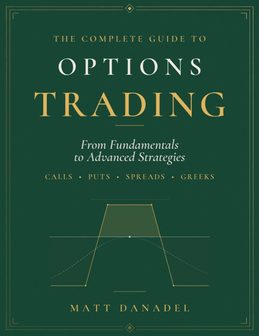
The way off the gambling side of the line, for people who conclude they want these instruments in their life at all, is not abstinence and it is not willpower. It is pricing. The trader who can compute what a contract is worth, the way the desk on the other side computes it, has replaced the question “do I feel lucky” with the question “is this cheap,” and those two questions produce different lives. That skill is genuinely learnable, and it is the entire early spine of The Complete Guide to Options Trading: Chapter 9 teaches the expected-value arithmetic that casinos and options desks both price with, and Chapter 26 turns it, without flattery, on the same-day contracts in the table above.
If this started to feel personal
One more thing, because the search that brought you here sits two clicks from some very different pages, and a fraction of the people typing it are not asking about options at all. They are asking about themselves. If the FCA’s screening numbers above landed somewhere specific, if trading has started costing money you had promised elsewhere, or stopped being something you can leave alone on a bad week, that has a name, gambling disorder is a recognized condition and not a character flaw, and there is a real place to start: the National Problem Gambling Helpline, run by the National Council on Problem Gambling, reachable by call, text, or chat at 1-800-MY-RESET, with contact centers covering all 50 states. Markets will still be here afterward. They always are.
That is the honest map of this question. The instrument is real machinery with real jobs, the gambling is real behavior with real measurements, and the two share a login screen. Where the line runs is never hidden from anyone willing to look at their own positions the way the researchers above looked at everyone’s.
Keep going
The Complete Guide to Options Trading$99.99
This article can show you where the line runs; it cannot teach you to price a contract, and pricing is the skill that keeps a trader on the right side of it. The Complete Guide to Options Trading builds that skill deliberately: the casino's own expected-value arithmetic in Chapter 9, the same-day market told straight in Chapter 26, and the sizing discipline in Chapter 41 that keeps even a real edge from ruining you. What the book will not do is make the gambling version profitable. No book can. It teaches you to know, with arithmetic instead of adrenaline, which version you are holding.
Questions, answered straight
Are same-day options gambling?
Same-day contracts, usually called 0DTE, are the corner of the options market where the gambling job concentrates, and the numbers say it is a large corner: by Cboe's count, they were 59% of S&P 500 index option volume in 2025. Same-day resolution delivers the fast feedback that gambling products are built around. Defined-risk professional uses exist, and hedging desks use these contracts all day. The expiration date does not decide which activity you are doing; the reason you entered does.
Is selling options gambling?
No, and it does not make you the casino either. A seller collects many small wins and, eventually, losses large enough to cancel them, which is why a high win rate alone is not evidence of an edge. The only participant with a built-in advantage is the one collecting the spread. Context decides the rest: a call sold against shares you own is among the most conservative options positions available, while an uncovered promise sold for the thrill of collecting premium is a gamble with an open-ended bill.
How do I know if my options trading is gambling?
Look at motives and shape rather than results. Warning signs the research keeps finding: excitement is the real draw, the fastest expirations keep winning your attention, sizes creep upward after losses, and the trading happens because the app pinged you rather than because a thesis matured. A useful check is to ask what you would pay for the same position if it settled silently in a month. If the answer is less, part of your stake is buying entertainment.
Are the odds in options worse than a casino?
The structure is different. A casino game carries a fixed, published edge for the house, so every bet is priced against you by a known amount. An options contract has no house percentage: both sides can pay a fair price, and the dependable cost is the spread and fees charged on the way in and out. Research on retail options buyers shows they measurably overpay around exciting events, so in practice, excitement raises the toll. The odds are not rigged. They are billed.
Keep reading
Everything here is education, not financial advice. How I source numbers and handle corrections: Editorial standards. The full risk language: Disclaimer.