Options · The blog
Calls and puts, explained without the jargon
The short answer
Somewhere in a drawer you probably have a receipt with a sentence on the bottom: returns accepted within 30 days. That sentence is a put option. For one month you hold the right, and never the obligation, to sell the sweater back to the store at the full price you paid, no matter what happens to sweaters in the meantime. If it goes on sale for half price next week, your right protects you. If you love it, you let the right quietly expire. Stores also sell the other contract: when an advertised item runs out and the clerk writes you a rain check, you hold the right to buy at today’s price later, even if the price has gone up by the time you come back. Nobody finds either idea difficult, and nobody thinks of themselves as trading derivatives at the mall.
Calls and puts are those two pieces of paper, formalized. The vocabulary around them is what makes the subject feel closed: strike, premium, exercise, expiration, in the money. So this article does the explaining in a specific order: first the two contracts in the words of the market’s own rulebook, then the four terms that do all the work, then real numbers, then the side of the counter nobody explains to beginners. It is a large subject to enter through one page, and an enormous market to enter casually, so the goal here is precision rather than speed.
The two contracts, in the rulebook’s own words
Options have an official definition, and it is better than most paraphrases. Every US broker is required to hand options customers a document called Characteristics and Risks of Standardized Options, written by the Options Clearing Corporation, the institution that stands behind every listed options contract in the country. Its June 2024 edition defines the entire subject in three sentences: “An option is the right to buy or sell a specified amount or value of a particular underlying interest at a fixed exercise price by exercising the option before its specified expiration date. An option that gives the right to buy is a call option, and an option that gives a right to sell is a put option. Calls and puts are distinct types of options, and buying or selling of one type does not involve the other.”
Read the receipt and the rain check into that language and the whole structure appears. The rain check is the call: a right to buy at a fixed price, valuable when the price of the thing rises. The return policy is the put: a right to sell at a fixed price, valuable when the price of the thing falls. The one difference between the mall versions and the market versions is that the store gave you yours for free. In the market, every right has a seller who demands payment for granting it, and that payment, the premium, is where all the difficulty and all the interest of this subject actually live.
The call and the put
The call
- The right to buy at the strike price
- Its everyday cousin: the rain check
- Gains value as the stock rises
- Bought for a premium; that premium is the maximum loss
- One contract covers 100 shares
The put
- The right to sell at the strike price
- Its everyday cousin: the return policy
- Gains value as the stock falls
- Bought for a premium; that premium is the maximum loss
- One contract covers 100 shares
Two separate contracts, not two ends of one. Each can be bought or sold, and everything difficult in options follows from which of those four positions you hold.
The rulebook’s own worked example is worth keeping because every broker’s chain will present exactly this shape: “A physical delivery XYZ 40 call option gives the option holder the right to purchase 100 shares of XYZ stock at an exercise price of $40 a share.” One hundred shares per contract is the multiplier, and it is the first number that surprises people: premiums are quoted per share, so a call quoted at $0.90 costs $90, and the tidy column of small numbers on an options chain is actually a column of hundreds-of-dollars commitments. Listed options exist on more than individual stocks; the same document lists equity securities and fund shares, indexes, debt securities, and foreign currencies as the underlying interests currently traded, though stocks and ETFs are where nearly every beginner starts and where every example here lives. This market is anything but a corner: by Cboe’s count, options on the S&P 500 index alone averaged millions of contracts a day in 2025.
The four terms that do all the work
Everything on an options chain reduces to four ideas, and none of them needs jargon to survive.
The strike price is the number written into the contract: the fixed price at which the right operates, whatever the market does. The rain check names the sale price; the strike names the transaction price. Strikes come in a ladder, set by the exchange above and below the current stock price, and choosing one is choosing how ambitious the right you are buying is.
The premium is what the right costs today, and it is the only number in the contract that the market negotiates from minute to minute. Everything else, strike, expiration, contract size, is standardized. What makes a premium fair, and what it is made of, is a genuine subject of study rather than a definition, and it is the part of options a definitional page cannot teach.
The expiration date is when the arrangement ends, and the rulebook is unsentimental about it: “If an option has not been exercised prior to its expiration, it ceases to exist — that is, the option holder no longer has any rights, and the option no longer has any value.” Sweaters and receipts again: on day 31, the return counter does not negotiate. An option is the rare financial position with a printed death date, and that date changes everything about how owning one feels.
To exercise is to actually use the right: buy the shares at the strike (a call) or sell them at the strike (a put). When you may exercise depends on the option’s style, a detail worth knowing before it matters. American-style options, which include the standard options on individual stocks, can be exercised any time up to expiration. European-style options, which include many index options, can be exercised only at the end. The names are historical accidents, not geography, and for most beginners the practical difference is small, since most positions are closed by selling rather than exercising. But the style is printed in the contract’s specifications, and professionals check it the way pilots check fuel.
Traders also grade options by where the stock currently sits relative to the strike. An option is in the money when the right is currently worth using: a call whose strike sits below the stock price, a put whose strike sits above it. The rulebook’s example is compact: “If the current market price of XYZ stock is $43, an XYZ 40 call would be in the money by $3.” An option is out of the money when the right is not currently worth using, and at the money when the strike and the stock price sit together. None of these phrases carries a judgment about profit, because being worth using says nothing about whether it was worth buying, which is a distinction the next section makes concrete with real numbers.
One month, one call, real numbers
Put the pieces together with numbers small enough to hold in your head. A stock trades at $48. The one-month $50 call is quoted at $0.90, so one contract costs $90 and grants the right to buy 100 shares at $50 any time in the next month. For that right to pay for itself at expiration, the stock must finish above $50.90: the strike, plus the premium already spent.
Where the $50 call starts earning
Now run the month twice. If the stock climbs to $53, the right to buy at $50 is worth $3 a share at expiration, $300 a contract, against $90 paid: a large percentage gain on a small stake, which is the honest appeal of the instrument. If the stock instead drifts to $49, up from $48, the shareholder made money, and the $50 call expired holding no rights and no value. The stock rose and the call buyer still lost everything staked. That asymmetry is not a flaw; it is the deal: a premium buys leverage to a move, priced with a deadline, and a move that arrives too small or too late pays nothing.
The put mirrors it exactly. The same stock’s one-month $46 put at $0.85 costs $85 and starts earning at expiration below $45.15. A holder of 100 shares who buys it has set a guaranteed floor under a month of ownership, which is why careful investors sometimes describe puts with no excitement whatsoever. The same contract bought by someone who owns nothing is a bet on decline with a known maximum cost. Same put, two different jobs, and if that distinction interests you, what options are actually for treats it properly.
The other side of the counter
Every one of these rights is granted by somebody, and the rulebook gives that person a name and a burden: “The option writer is obligated — if and when assigned an exercise — to perform according to the terms of the option.” The writer collected the premium on day one. In exchange, if the holder uses the right, the writer must take the other side at the strike, at whatever the market then charges. The document states the arithmetic of the whole system in one sentence worth reading twice: “Since every options transaction involves both a holder and a writer, it follows that the aggregate rights of option holders under the system are matched by the aggregate obligations of option writers.”
Writing options is not exotic, but it is a different animal from buying them, because the risk runs the other way: the writer’s income is capped at the premium and the obligation is not. A writer who owns the 100 shares her call obligates her to deliver is covered, and her risk is the rally she agreed to miss. A writer with nothing behind the promise is uncovered, and brokers reserve that position for their highest approval tiers because the potential bill has no ceiling. Buying calls and puts risks the premium; writing them risks the future, which is why the industry’s own paperwork, this same disclosure document, exists at all: it is distributed under an SEC rule precisely because these contracts can carry risks that a stock certificate cannot.
Where the vocabulary ends and the subject begins
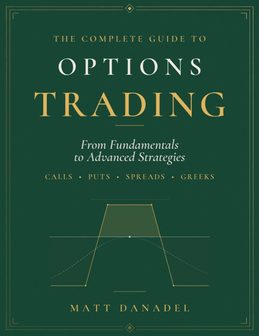
Here is an honest statement of where this article leaves you. You can now read an options chain: every row is a strike, every price is a premium per share times one hundred, calls on one side, puts on the other, an expiration on the tab. That is the whole vocabulary, and it is genuinely everything a definitional page can deliver. What it cannot deliver is the subject: why that $50 call costs $0.90 rather than $2.00, what the price is made of, and how the person on the other side decided the premium was worth granting your right for. The definitions are free everywhere. The pricing is where options are actually won and lost, and it is the point at which The Complete Guide to Options Trading stops being optional reading, because its Chapters 4 through 9 rebuild everything this article defined, with the arithmetic attached.
The mall will keep handing you options for free, and now you will notice. The market charges for them, every day, by the hundred shares, and the fair price of a right is one of the most interesting questions in finance. Learning to answer it is the difference between knowing the words and speaking the language.
Keep going
The Complete Guide to Options Trading$99.99
This article gives you the vocabulary; the book gives you the machinery underneath it. The Complete Guide to Options Trading rebuilds calls and puts from the contract up: Chapters 4 and 5 teach each contract completely, Chapter 6 opens the premium to show what it is made of, and Chapter 8 teaches you to read a live chain the way a professional does. It assumes nothing, and it does not skip the arithmetic that definitional pages, including this one, must leave out.
Questions, answered straight
What is the difference between a call and a put?
A call is the right to buy a stock at a fixed price by a fixed date, and it becomes more valuable as the stock rises. A put is the right to sell on the same terms, and it becomes more valuable as the stock falls. They are separate contracts, not two ends of one: buying a call and selling a put both lean bullish, but the call risks only its premium while the sold put carries an obligation.
Do I have to exercise an option to take a profit?
No, and most people never do. An option that has gained value can simply be sold in the market any trading day, the way you would sell a share, and the profit is the difference between the premium paid and the premium received. Exercising is for the minority who actually want to buy or sell the underlying shares at the strike. Most positions end by being closed, not exercised.
Is buying a put the same as short selling?
They express the same opinion with very different risk. A short seller borrows shares, sells them, and loses money without limit if the stock keeps rising, while paying borrowing costs along the way. A put buyer pays a premium once, and that premium is the most the position can ever lose, no matter what the stock does. The put's cost is certain and its deadline is fixed; the short's cost is open on both ends.
What does one options contract actually cost?
The quoted premium times one hundred, because a standard equity contract covers 100 shares. A call quoted at $0.90 costs $90, plus commissions where they apply. This multiplier is the least-mentioned number on the options chain and the one that most often surprises beginners: a screen full of prices under $3 is really a screen full of positions costing hundreds of dollars each.
Keep reading
Everything here is education, not financial advice. How I source numbers and handle corrections: Editorial standards. The full risk language: Disclaimer.