Investing · The blog
What is an index fund, and how do you pick one?
The short answer
Anna has now been told three times, by three different people, what to do with her money. Her sister said it at a wedding. A podcast said it during her commute. A coworker said it over lunch, with the confidence of a man revealing a password: just buy index funds. Anna nods every time. She has no idea what an index fund is, and it is somehow already too late to ask, because the words are said the way people say wear sunscreen, as if the matter were settled somewhere above her head. The advice is fine, as it happens. It might be the only financial advice strangers give each other that survives scrutiny. But advice you follow without understanding is fragile, and the first bad month will test exactly the part nobody explained.
So here is the explanation Anna never got, in full, and then the part “just buy index funds” always skips: how you actually choose one, which turns out to take three checks and about ten minutes. The stakes hide in that gap. Not understanding what you own is survivable in good years; in bad ones it is why people sell things they were right to buy. Understanding the machine you are holding, and what its label does and does not promise, is most of what this article is for.
A list with money attached
Start with the index, because the fund is the easy part. An index is a published list of investments built to represent a market. The S&P 500 is a list of about five hundred of the largest U.S. companies; a total market index is a longer list that includes the smaller ones too. The list is maintained by an index provider whose job is deciding what belongs on it, and the list’s combined performance, every company weighted and summed, is what people mean when they say “the market was up today.”
Indexes existed long before anyone thought of selling them. They were invented as measuring sticks: one number a newspaper could print to say how the whole market did, and one benchmark every paid manager could be graded against. The idea behind the index fund was almost impertinent. If the stick is the thing the professionals keep failing to beat, stop hiring professionals and buy the stick. The product is the benchmark itself, purchased directly, and nearly everything unusual about index funds follows from that inversion.
An index fund, then, is a fund that copies the list. That is the entire trick. The SEC’s investor education site defines it in one sentence: “An ‘index fund’ is a type of mutual fund or exchange-traded fund that seeks to track the returns of a market index.” Where an ordinary fund pays professionals to pick which stocks deserve your money, an index fund’s only ambition is fidelity: hold what the list holds, in the list’s proportions, and deliver whatever the list delivers. Buy one share and your money spreads across every company on the list at once, five hundred or several thousand of them, in a single purchase.
Notice what that job description removes. No research department hunting winners. No star manager to pay, or to lose. No judgment calls to second-guess, because there are no judgment calls. The industry names this approach passive investing, which sounds like a criticism and is actually the product: you are buying the market’s whole result while declining to pay for anyone’s opinion about which slice of it will win.
How the list runs itself
A fair question about any machine is who is steering, and for an index fund the answer is arithmetic. Most broad lists are weighted by company size, which the industry calls market-cap weighting: the larger a company’s total stock market value, the bigger its slice of the list, and therefore of your money. Nobody votes on those proportions. A company that doubles in value becomes twice as large a share of the index automatically, and one that shrinks fades from significance the same way, so the fund never faces a decision about when to let a winner run or cut a loser loose. The weighting is the decision, recomputed continuously by prices themselves. When a company is acquired, collapses, or no longer qualifies, the index provider drops it from the list, adds the replacement, and every fund copying the list follows within days, without you hearing about it.
Two consequences of size-weighting belong in plain view before you own one, because both eventually show up in the experience. The first is concentration: a size-weighted list always tilts toward its current giants, so “owning the whole market” in practice means owning a great deal of whatever is largest at the moment, and the top handful of names will move your fund more than the bottom hundreds combined. The second is the consolation: the same arithmetic that rides champions upward also demotes them when their day passes, which is a discipline human managers famously struggle to apply to their favorites. The list has no favorites. That is most of what you are buying.
The price of an opinion, measured
Declining to pay for opinions turns out to be worth measuring precisely, and the fund industry’s own trade association does it every year. The Investment Company Institute’s 2025 report on fund expenses prices the difference between managed and copied portfolios.
What management costs, per year
| The fund's approach | Average yearly fee on each $10,000 | As an expense ratio |
|---|---|---|
| Actively managed U.S. equity mutual funds | $64 | 0.64% |
| Index equity ETFs | $14 | 0.14% |
| Index equity mutual funds | $5 | 0.05% |
Actively managed U.S. equity mutual funds
Average yearly fee on each $10,000$64
As an expense ratio0.64%
Index equity ETFs
Average yearly fee on each $10,000$14
As an expense ratio0.14%
Index equity mutual funds
Average yearly fee on each $10,000$5
As an expense ratio0.05%
One row of that table needs a word of explanation, because on its own it will mislead you. The 0.14% for index ETFs is an average across every index equity ETF on the market, from broad total-market funds to narrow sector and thematic products, and it is not the price of the fund this article is describing: a broad total-market ETF from a major provider charges around 0.03%, and the floor is genuinely zero, since Fidelity’s four ZERO index funds charge 0.00%. ICI’s own report makes the spread visible. The simple average across all index equity ETFs, counting each fund once, is 0.45%; the asset-weighted average, which is what shareholders actually paid, is that 0.14%, and the report explains the gap in a sentence worth keeping: it indicates “that ETFs with lower expense ratios tend to have greater assets.” Investors are already voting with their money, and the cheap end is where they went.
Five dollars a year against sixty-four, per $10,000 invested, every year, compounding. That gap is the entry fee for active management, paid before the manager has beaten anything, and whether managers earn it back is not a matter of opinion either: S&P Dow Jones Indices has kept a public scorecard for more than two decades, and across long windows most professional stock pickers trail the plain index they are measured against. The full record, with the actual percentages by decade, is laid out in how to start investing, and it is the reason the advice Anna keeps hearing has hardened into folk wisdom. The copy has been beating the opinions, net of fees, for most of the time anyone has measured.
One honest note belongs beside that table: cheap is a habit of index funds, not a law. The same SEC page that defines them carries a warning worth quoting exactly, because the label gets abused: “not all index funds have lower costs than actively managed funds. Always be sure you understand the actual cost of any fund before investing.” An index fund tracking something narrow and fashionable can charge active-fund prices for passive work. The word index on the label promises a method, never a price.
There is also a cost advantage hiding off the fee table entirely: trading itself. A fund that only transacts when its list changes sells rarely, and selling inside a fund is what generates the capital gains distributions funds must pass to their holders at year-end. Inside a retirement account the difference is invisible, since nothing there is taxed as it goes. In an ordinary taxable account, the copy’s stillness is one more quiet way it outruns the opinions, year after year, without appearing on any comparison chart.
The three checks that pick one
Which brings us to the half of the question those four words never cover. Picking an index fund sounds like a research project and is actually three short checks, run in order, on the fund’s own page.
Choosing an index fund, in order
- 1
What list does it track?
For a first or only fund, broad beats clever: a total U.S. market index or the S&P 500, which behave almost identically. A fund tracking one industry, one theme, or one country is a concentrated bet wearing the index label.
- 2
What does it charge?
Find the expense ratio. Broad index funds from the major providers charge roughly 0.00% to 0.10%. The ICI's 2025 asset-weighted averages were 0.05% for index equity mutual funds and 0.14% for index equity ETFs, the latter spanning everything from total-market to narrow sector funds. A broad fund charging many times 0.10% needs a reason. FINRA's free Fund Analyzer compares any funds' costs over time.
- 3
Which form suits how you buy?
The same list usually comes as an ETF, which trades all day, and as a mutual fund, which prices once daily. For scheduled automatic buying, either works at the major brokerages; this decision should take minutes, not weeks.
The checks matter in that order. The list decides what you actually own, the cost decides what you keep of its result, and the form is mostly logistics. Run them and something anticlimactic happens: the broad, cheap funds from the handful of giant providers all pass, and the differences between the passing candidates shrink to hundredths of a percent. That anticlimax is the answer. When every finalist is nearly identical, the choice stops deserving anxiety, and FINRA’s Fund Analyzer exists for the moments you want the comparison made explicit, over 30,000 funds, fees projected over time, for free.
What the label does not promise
Every honest definition owes you the limits, and index funds have real ones, stated plainly by the same regulator that defines them. The SEC’s page lists the risks in three words apiece, and two deserve translation because they will eventually matter to you.
Lack of flexibility means the fund holds the list, all of it, always. When the market falls, an index fund falls with it, completely, because refusing to swerve is its entire design. Nobody is at the wheel during a crash for the same reason nobody is at the wheel during a rally; what to do in those falling stretches has its own article, and the answer starts with expecting them. Tracking error means the copy can drift a hair from the original, since running even a passive fund costs something and the mechanics are imperfect; on a broad fund from a major provider the drift is typically tiny, and a fund whose returns wander far from its index is failing at its one job.
And one limit the SEC leaves implied: an index fund is exactly as sensible as its index. The label has been attached to lists of one industry, one fashionable theme, one country’s small caps, products that are legitimate index funds by structure and concentrated speculations by content. The definition Anna needed is not “index fund equals safe.” It is: an index fund gives you precisely what its list contains, cheaply and faithfully, and every question worth asking is really about the list.
The four words, translated
So the advice Anna keeps receiving unpacks to this: buy the whole market’s list, through a fund that copies it for a few dollars a year, in whichever form your account buys automatically, and then let the list do what the list does across decades. The wedding, the podcast, and the coworker were all abbreviating that sentence, and the abbreviation works fine right up until the first year it doesn’t, when the market drops and the only thing holding an investor in place is knowing what they own and why. Anna, now, knows: a list with money attached, the market’s own result at close to no cost, chosen in three checks and held on purpose.
What she does next, the account that should hold the fund, the amount that should flow into it, and the automation that keeps it flowing, is a different question from what a fund is, and it has a complete answer in this section’s guide to starting from nothing. The short version is that the fund turns out to be the easy part, which is the last thing the vocabulary would ever let a beginner suspect. That discovery, more than any ticker symbol, is the thing the four words were trying to hand her all along.
Keep going, free
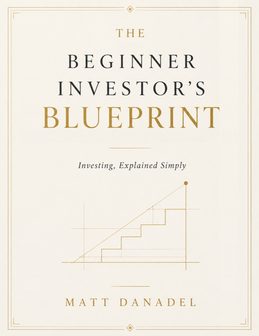
The Beginner Investor's BlueprintFree
This article explains the machine. The Beginner Investor's Blueprint installs it: which account to open first, real example funds named and compared, the exact taps that buy one in dollar amounts, and the automation that keeps buying it every payday, ending with your first $100 actually invested. It costs nothing, and nothing is held back.
Questions, answered straight
Is an index fund the same as an ETF?
They overlap without being the same thing. Index fund describes the strategy: copying a list. ETF and mutual fund describe the package it comes in: an ETF trades all day like a stock, while a mutual fund prices once each evening. An index fund can be either, and the same list is often sold both ways. For an automatic monthly buyer the difference barely matters; both forms take scheduled dollar amounts at the major brokerages.
Are index funds safe?
Safe from one thing, not the other. Holding hundreds or thousands of companies means no single bankruptcy can do serious damage, which removes the risk that ruins stock pickers. What remains is the market itself: a broad index fund falls in every crash, fully, with no manager stepping in front of it. The SEC lists that lack of flexibility plainly among index fund risks. The protection against market falls is time, not the fund.
Which index fund should a beginner buy?
This site teaches rather than advises, so here are the criteria instead of a ticker: a fund tracking a broad market list, either a total market index or the S&P 500; an expense ratio near the index average of 0.05%, per the Investment Company Institute's 2025 data; and the plain long-running version from a major provider, not a themed variation. Several funds from the large firms fit, and the differences between them are rounding errors.
Do index funds pay dividends?
Yes. The companies inside the list pay dividends, and the fund passes them through to you, typically quarterly. You can have them reinvested automatically, which buys more shares and lets the compounding run without any attention. In a retirement account those dividends are not taxed as they arrive, which is part of why the account choice around the fund matters nearly as much as the fund.
Keep reading
Everything here is education, not financial advice. How I source numbers and handle corrections: Editorial standards. The full risk language: Disclaimer.